DHI Seed Project 2025/26
A Hyperlinked Edition of the Huainanzi
Learning and Growth Through the Project
by Lakshya AGARWAL
Year 1, BEng in Computer Engineering
As a first-year Computer Engineering major, working on the intertextuality tool for the Huainanzi has been a remarkable experience that deeply resonated with my academic as well as technical interests. It is never easy to find experience when you’re a few months into university, and this project offered that and more.
My role centered around designing and building a web application that lets readers explore this classical Chinese text alongside its parallel passages in other works. This project allowed me to merge digital humanities, research, and software development in a meaningful way.
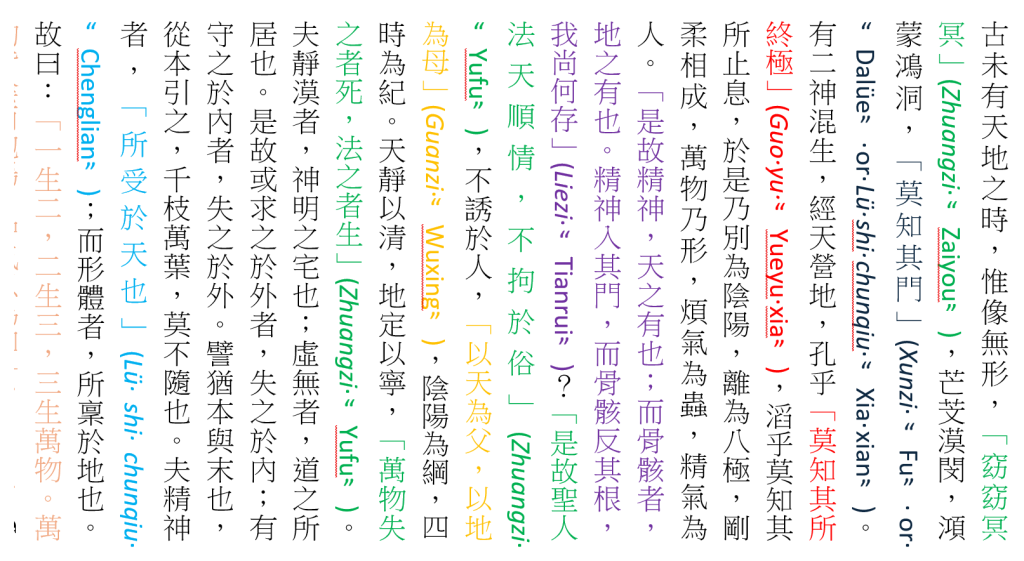
As someone who does not speak Chinese, my main task began with understanding the Huainanzi itself. I spent a lot of time researching its structure, its ideas, and why it draws from other works. This was when I started to understand the problem, that all the information related to parallels existed but was scattered across the web and other scholarly pieces with no way of tracking them down. This also gave me a new appreciation for how much work goes into this kind of research.
Technically, we worked across a React frontend built with the Vite framework. Visually, we wanted the final product to follow an Apple-like design philosophy—something which is minimal yet intuitive and easy to use. We also spent a lot of time researching embedding-based similarity search and other ML techniques, thinking carefully about how to represent classical Chinese text in a way that actually made sense.
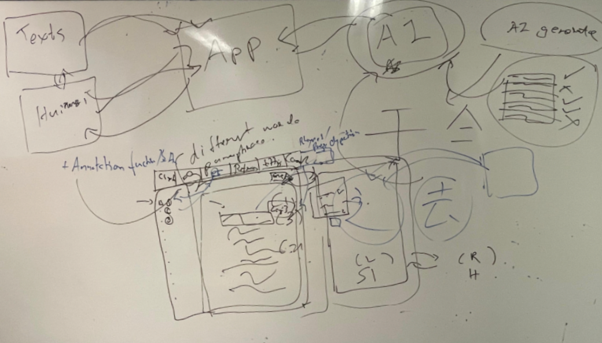
Another fun challenge was learning to utilize AI tools to build the web application itself, something I hadn’t done before on this scale. It was quite interesting to see how my working process changed, sketching out what I wanted a feature to do, reviewing what came back, and rewriting the parts that did not fit. A few times I accepted something too quickly and had to backtrack, which taught me to review the code as carefully as I would my own.
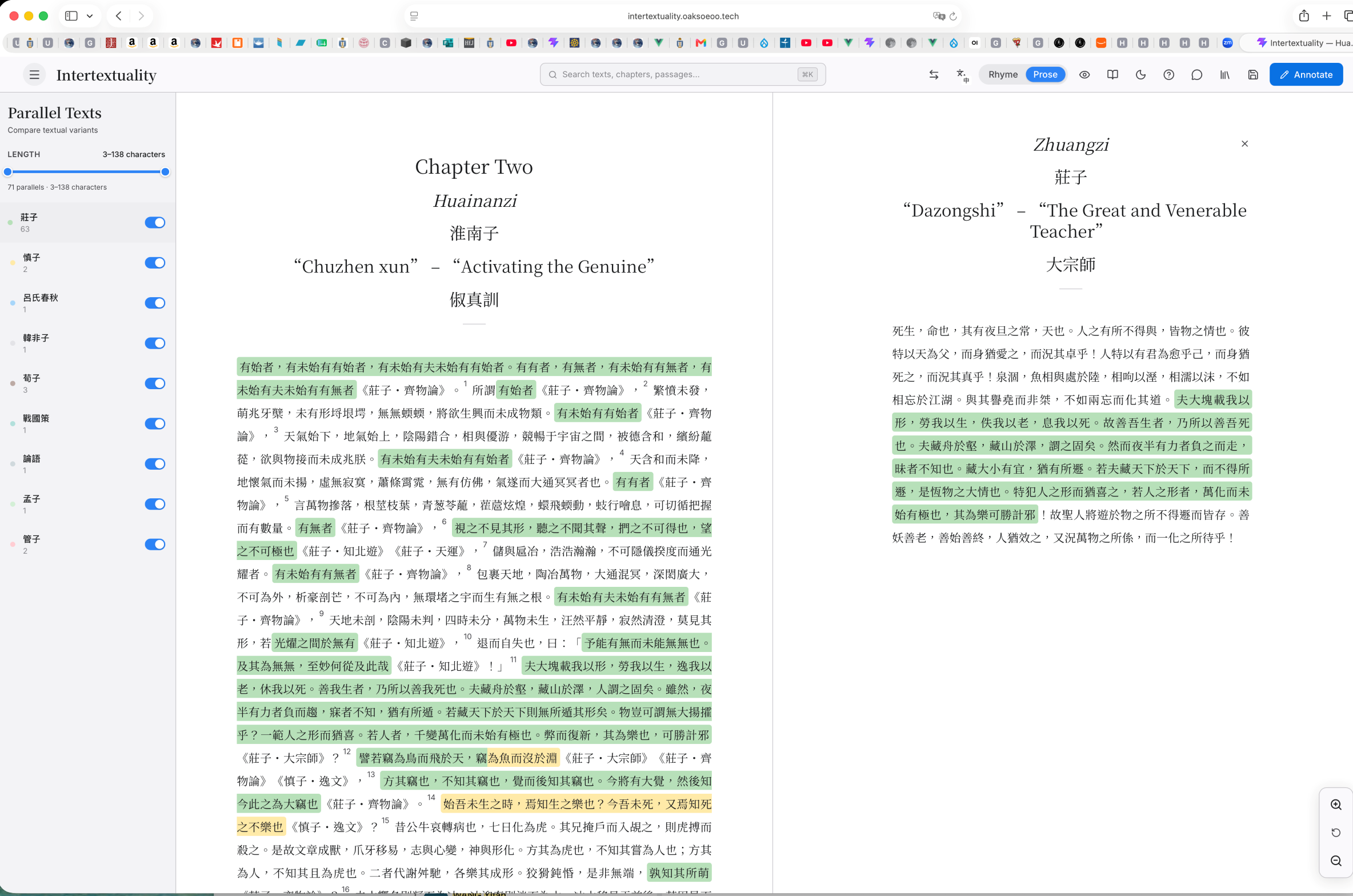
We have tried our best to develop an intuitive way to find and compare parallels across the Huainanzi and add other helpful tools for researchers such as universal search, custom annotations, text filtering, and more.
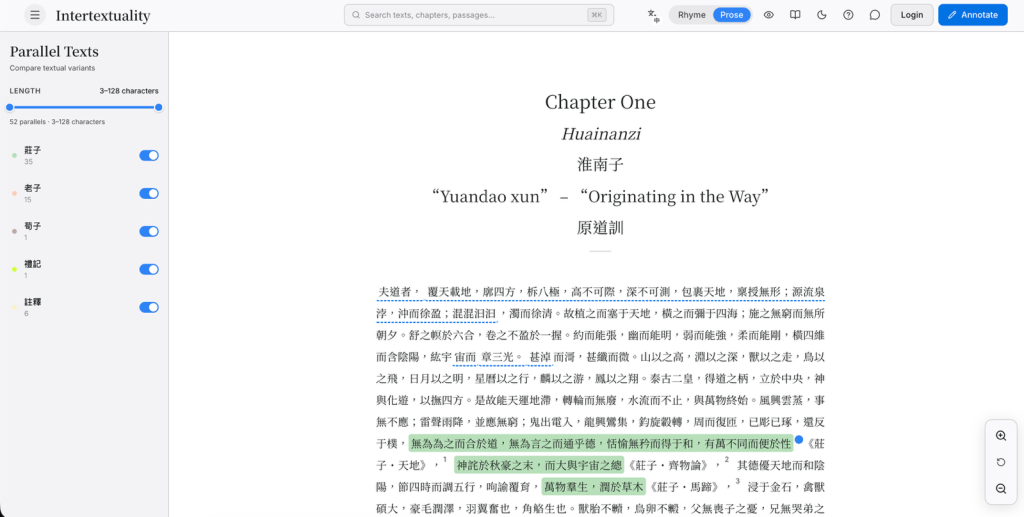
Seeing the tool come together in its current form fills me with a quiet sense of pride. I believe that it succeeds in making a difficult text a little more approachable while also preserving it digitally. There’s a ton of things that can still be added to it such as automating the parallel finding feature itself with the help of scraping tools and artificial intelligence, but for now, I am grateful for the chance to contribute towards something that matters, not only to us, but to many other historians and researchers across the globe.
As the project comes to an end, I leave with more questions than answers, but I take it to be a good thing, for I never would have thought of these questions when I initially started.