
26 March – July / Digital Humanities Seed Project
Principal Investigator: Prof. Tobias Benedikt ZÜRN
A Hyperlinked Edition of the Huainanzi
Cover Image:
Woven Textile, 206 BCE-220 CE, Artist/maker unknown, made in China.
Philadelphia Museum of Art: Purchased with the Bloomfield Moore Fund, 1934-2-1.
Project Background
The Huainanzi 淮南子 is a highly intertextual and comprehensive scripture from the early Western Han 漢 dynasty (206 BCE-9 CE) that Liu An 劉安 (c. 179-122 BCE), the king of Huainan 淮南, submitted to his nephew Emperor Wu in 139 BCE. Presumably produced with Masters of Methods (fangshi 方士) and several other retainers in the middle of the second century BCE, the Huainanzi contains ca. 130,000 characters (ca. 800 pages in English translation), of which it shares more than a third with various pre-Han texts (Le Blanc 1985: 79). For example, a typical section from the beginning of the “Essence and Spirits” (“Jingshen” 精神) chapter looks as follows (Zhang 1997: 719-22):
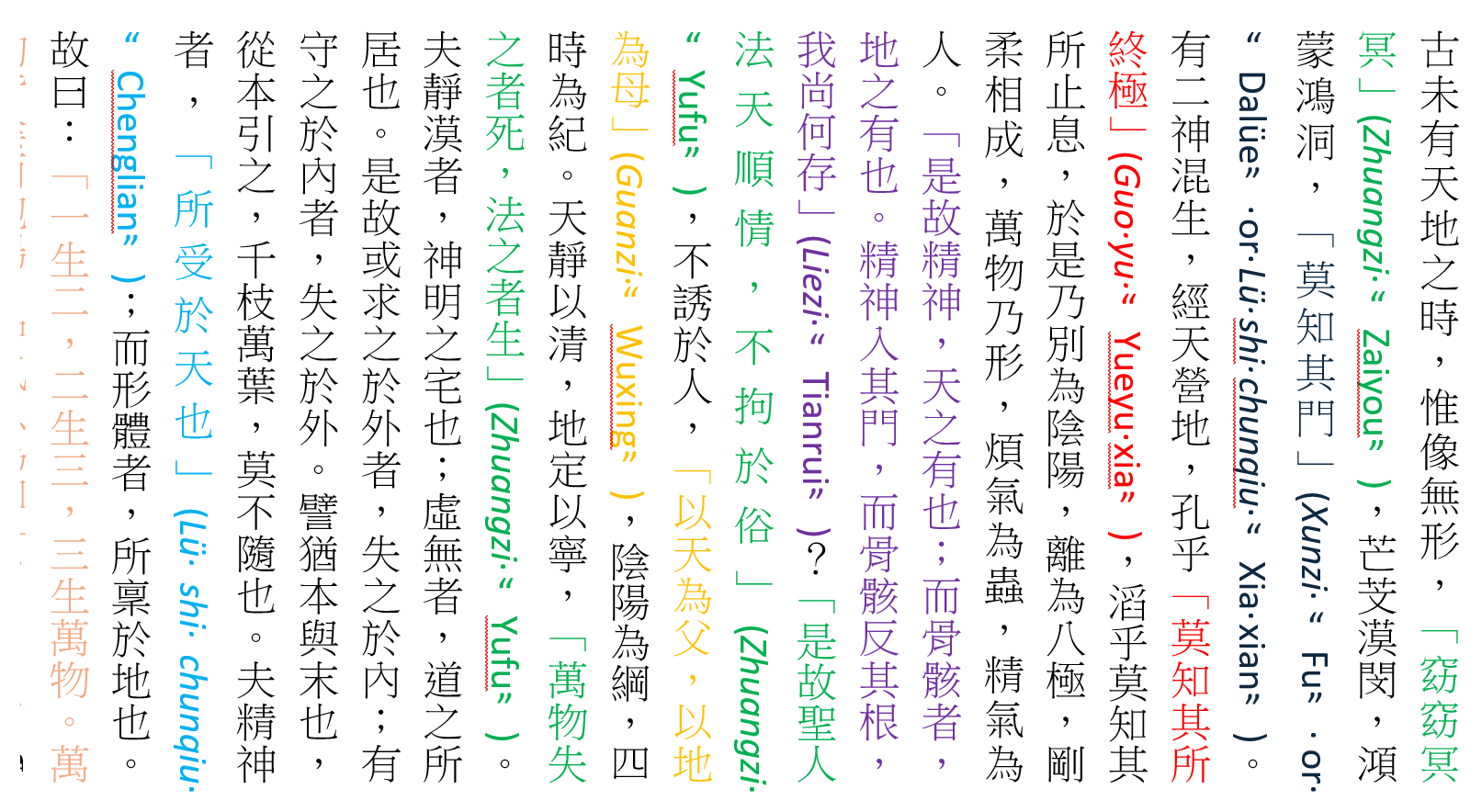
According to Sima Tan’s model of the Six Kinds of Expertise (liu jia 六家), the Huainanzi includes parallels with texts from a variety of traditions. The color-coded phrases would be variously attributed to the Confucian or Ruist (Xunzi 荀子), Daoist (Laozi 老子, Zhuangzi 莊子, and Liezi 列子), Legalist (Guanzi 管子) and Miscellaneous (Lü shi Chunqiu 呂氏春秋) “Schools,” as well as to historical writings such as the Discourses of the States (Guo yu 國語). In other words, the Huainanzi seems to connect and relate teachings from various writings of the Han and pre-Han period, weaving their words together into a unitary whole.
Due to this intertextual and syncretic design, which led to the Huainanzi’s classification as belonging to the Miscellaneous School (zajia 雜家), a bibliographical category that Ban Gu 班固 (32-92 CE) developed in his “Record of the Literature [of Artistic Writings]” (“Yiwenzhi” 藝文志) in the History of the Han (Hanshu 漢書), Liu An’s text has long been dismissed as an encyclopedia of mumbo-jumbo (Ban 1986, 30.166d). For example, several reformist intellectuals such as Fung Yu-lan 馮友蘭 (1895-1990), Hou Wailu 後外盧 (1903-1987) et al., and Wing-tsit Chan 陳榮捷 (1901-1994), as well as early Western sinologists such as Henri Maspero (1883-1945) dismissed the Huainanzi due to its highly constructed design and interpreted the “Liu Clan’s Scripture” (Liushi zhi shu 劉氏之書), as the Huainanzi refers to itself (Liu 2006: 711), as a mere encyclopedia that lacks originality and a cohesive intellectual program (Chan 1963: 305, Fung 1983: 396, Hou et al. 1957: 78, and Maspero 1924: 12).
This DH project suggests that these pejorative perspectives probably only developed since there was no edition of the Huainanzi available that consequently and clearly displays the intertextual design of Liu An’s text. Therefore, we want to generate a digital version of the Huainanzi that visualizes this peculiar feature. By developing a color-coded, hyperlinked interface and by making these materials and resources publicly available, our DH project will enable scholars to explore the Huainanzi’s intertextuality more efficiently, hopefully resulting in more dismissals of a pertinent yet problematic scholarly truism: namely that Liu An’s text is a thoughtless, mere hodge-podge of pre-Han thought.
Project Objectives
Our project generated a research tool for scholars worldwide to explore the Huainanzi’s intertextuality, helping substantiate the argument that Liu An and his erudite courtiers consciously and carefully utilized intertextuality as a means to emulate the practice of weaving in their writing practice (Zürn 2020).
Project Outcomes
Our website presents researchers with a wide variety of functionalities to explore the Huainanzi and its intertextual design.
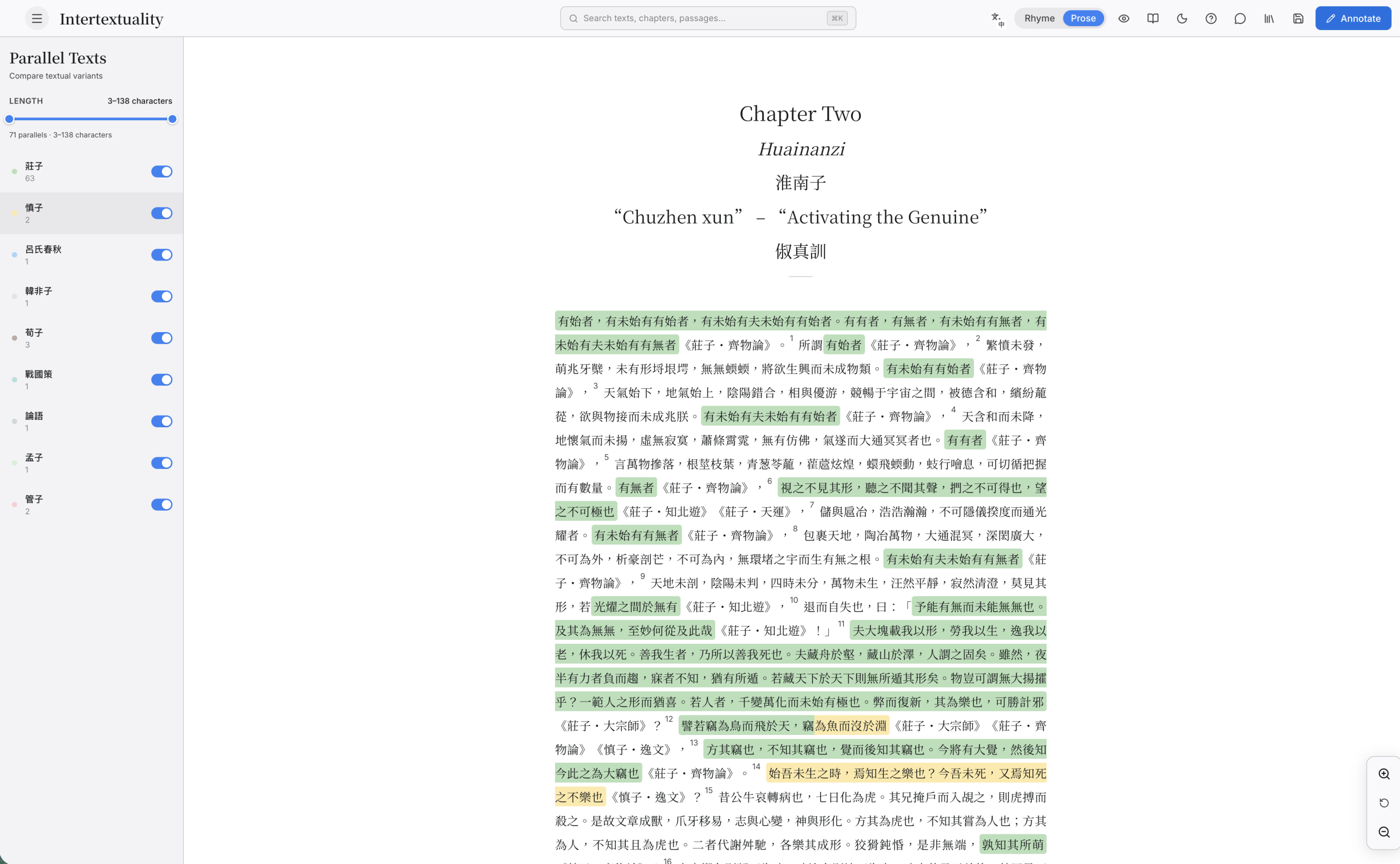
Screenshot 1: Display of the Main Surface.
Among others, it contains the following tools:
- Intuitive website that allows researchers to explore the Huainanzi’s intertextual design easily and readily (see Screenshot 1).
- Search function: The Huainanzi and its textual parallels are fully searchable.
- Zoom function and birds-eye perspective on the Huainanzi and its chapters: it enables researchers to easily recognize intertextual patterns.
- Annotation function: Our hyperlinked edition will allow researchers to annotate the text and export/import them into the website, creating a personalized user experience.
- Function to switch between rhymed and prose versions of the Huainanzi (Screenshot 3 and 4).
- Researchers can choose the texts whose textual parallels will be displayed on the screen, as well as the length of textual parallels.
- Researchers may easily switch between the Chinese and English versions of the Huainanzi and its textual parallels.
- Detailed list of references to scholarship central for the study of the Huainanzi.
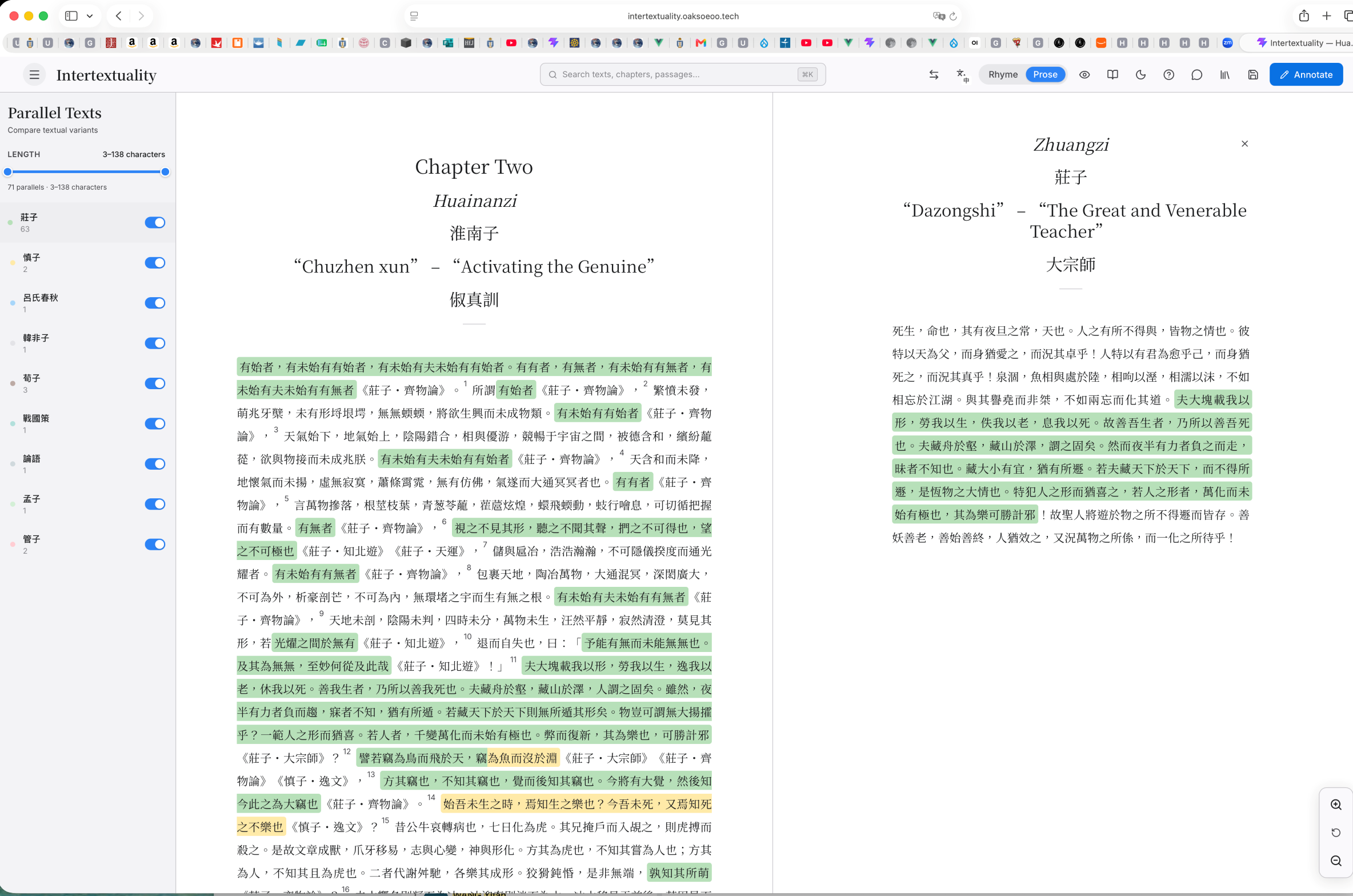
Screenshot 2: Illustration of how the project displays textual parallels.
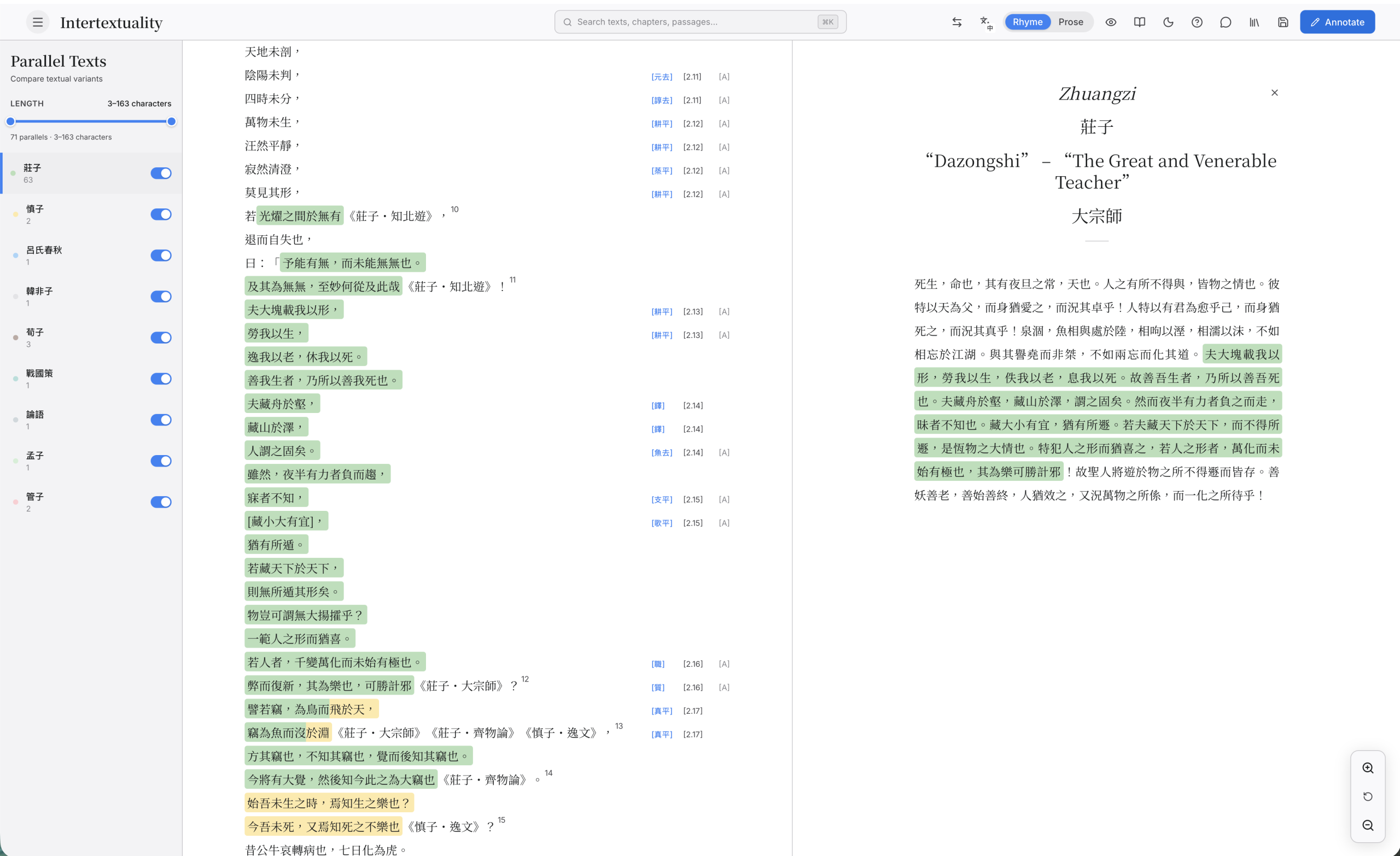
Screenshot 3: Display of the Huainanzi as a rhymed text.
At the end, our project provides the groundwork and blueprint for producing more digital editions of early Chinese classics that visualize their intertextual designs, opening new avenues to reading early Chinese classics and their intertextual networks beyond their printed editions.
What's Processed
Tracing back textual parallels is a tedious process.
To find and identify such parallels in the Huainanzi, our research project utilized two text-reuse softwares that are openly available: Donald Sturgeon’s ctext.org and Jeffrey Tharsen’s Text Alignments software (https://anomander.uchicago.edu/text-pair/chinese_classics/). After having generated a list of textual parallels between the Huainanzi and various pre-Han writings using these two tools, we read their findings against Prof. Zürn’s, manually curated list of textual parallels and adjusted the list accordingly.
In the next step, we carefully checked the list for false positives. Finally, we OCR’ed two critical editions in Chinese, Zhang Shuangdi’s 張雙棣 Huainanzi jiaoshi 淮南子校釋 and D. C. Lau’s 劉殿爵 Huainanzi yundu ji jiaokan 淮南子韻讀及校勘, as well as the only complete translation of the Huainanzi into English by John Major et al., and we generated prose and a rhymed base text in Chinese and a mixed version in English, in which we marked the textual parallels we found in our previous work steps.
By following all these steps, we were able to develop a carefully curated and citable hyperlinked edition of the Huainanzi that fulfills highest research standards.
Project Roadshow Talk
Prof. Zürn presented this project during its initial stage at the “A Taste of Digital Scholarship” Talk Series, held as part of the Library’s Digital Scholarship Roadshow on March 17, 2026. (More details →)
Challenges & Solutions
The project encountered various challenges.
First, it is a very time-consuming task to find and double-check all textual parallels and editions we used to make sure that our hyperlinked edition is citable. This is one of the reasons why it took us several months to finish the first two chapters. As a result, we will more efficiently scaffold the workflows in the future to avoid downtimes for the computer engineers in our project.
Second, it is not always easy to decide to which pre-Han text the Huainanzi refers. We solved this issue by including pop-up windows in our hyperlinked edition that provide all potential textual parallels when one clicks on the color-coded passages in the Huainanzi. In these windows, the parallel that is mentioned first is the most likely passage that the authors of the Huainanzi referred to according to our observations and analysis; however, each researcher may decide for themselves, to which passage the Huainanzi refers, since our website provides all parallels that we found (see Screenshot 5).
Lastly and most importantly, the current software to identify text-reuse finds a lot of false positive textual parallels. More importantly, it misses out on those that are less obvious and clean. To improve the results, we decided to develop an NLP in the future that is specifically designed for the Huainanzi and pre-Han writings. In so doing, we are convinced that we will be able to identify textual parallels and allusions more efficiently than the current software allows.
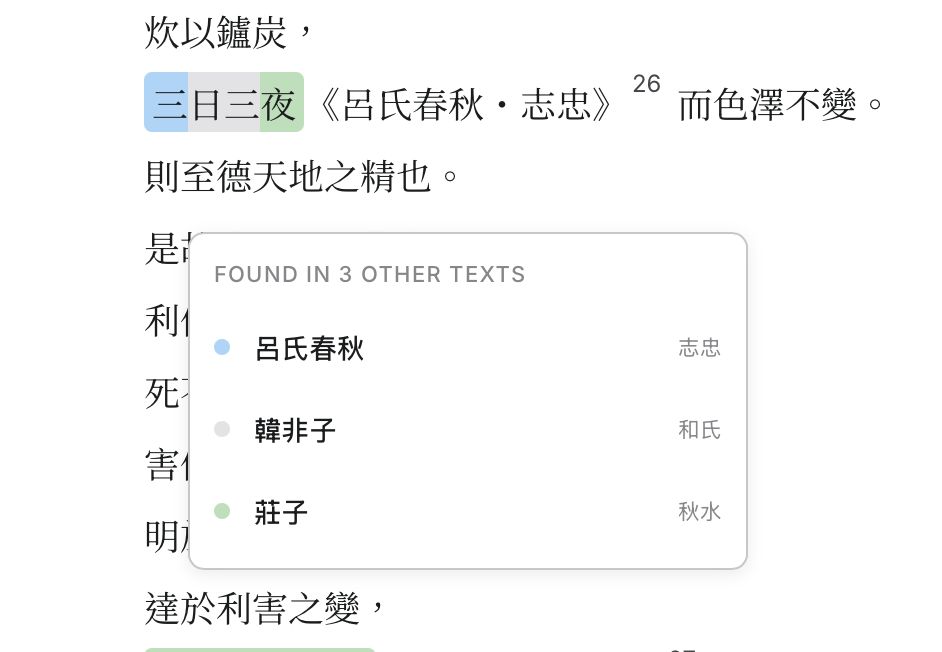
Sreenshot 4: Pop-up window showing various potential textual parallels.
What's Next
In addition to offering various Undergraduate Research Opportunities Program (UROP) courses related to the project, Prof. Tobias Benedikt Zürn will apply for a GRF grant in Fall 2026 to generate funds so we can continue the work we have successfully initiated with the help of HKUST’s Digital Humanities Initiative.
The aim is to develop a hyperlinked edition of not only the first two chapters but the complete Huainanzi by the end of 2029. In addition, we aim to generate a patented blueprint for the production of hyperlinked editions that could be utilized for all kinds of early Chinese writings.
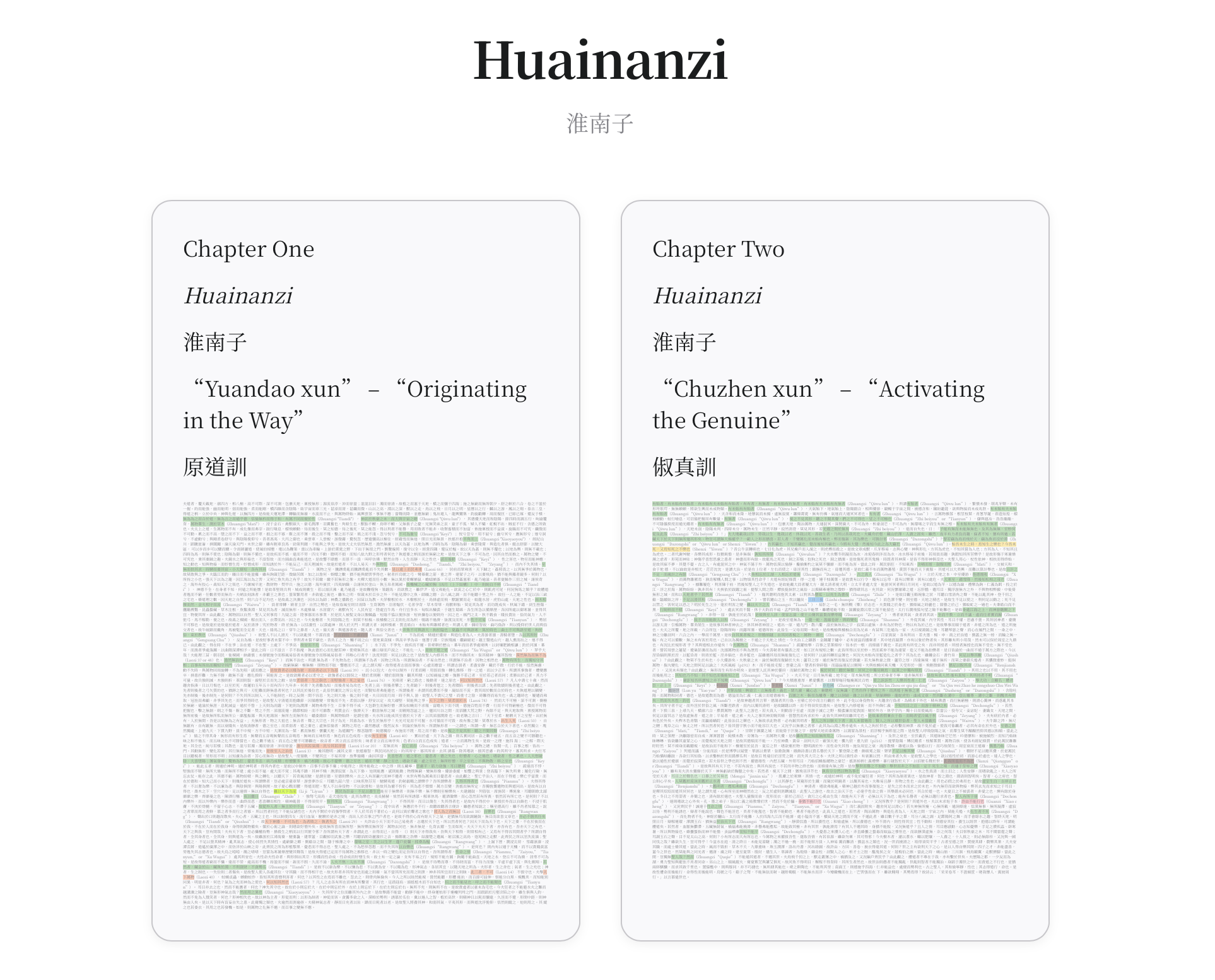
Sreenshot 5: The first two chapters of our hyperlinked Huainanzi.
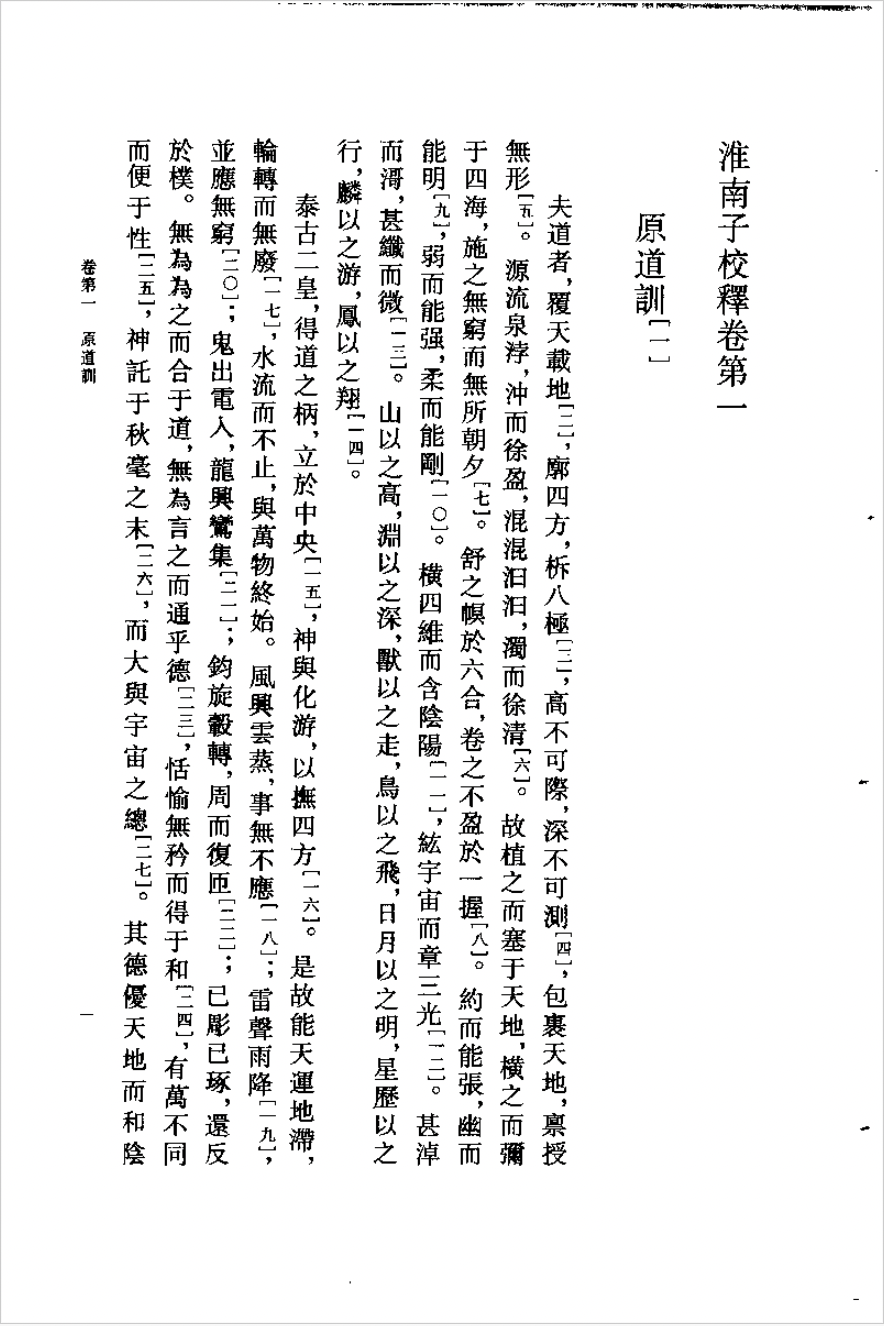
Sreenshot 6: Page from Zhang Shuangdi’s Huainanzi jiaoshi.
Bibliography
- Ban Gu 班固. 1986. Qian Hanshu 前漢書. In Ershiwu shi 二十五史 Volume 1. Shanghai: Shanghai guji chuban she.
- Chan Wing-tsit. 1963. A Source Book in Chinese Philosophy. Princeton: Princeton University Press.
- Fung Yu-lan. 1983. A History of Chinese Philosophy Volume 1. Translated by Derk Bodde. Princeton: Princeton University Press.
- Gao You 高誘. 2006. “Xumu” 敘目. In Huainan honglie jijie 淮南鴻烈集解. Edited by Liu Wendian 劉文典. Beijing: Zhonghua shuju chuban fahang.
- Hou Wailu 後外盧, Zhao Jibin 趙紀彬, Du Guoxiang 杜國庠, and Qiu Hansheng 邱漢生. 1957. Zhongguo sixiang tongshi 中國思想通史. Volume 2. Beijing: Renmin chubanshe.
- Lau, D. C. 劉殿爵. 2013. Huainanzi yundu ji jiaokan 淮南子韻讀及校勘. Hong Kong: The Chinese University of Hong Kong Press.
- Le Blanc, Charles. 1985. Huai-Nan-Tzu: Philosophical Synthesis in Early Han Thought. Hong Kong: Hong Kong University Press.
- Liu Wendian 劉文典 ed. 2006. Huainan honglie jijie 淮南鴻烈集解. In Xinbian zhuzi jicheng 新編諸子集成. Beijing: Zhonghua shuju chuban fahang.
- Major, John S., Sarah A. Queen, Andrew Seth Meyer, and Harold D. Roth, eds. and trans. 2010. The Huainanzi: A Guide to the Theory and Practice of Government in Early Han China. New York: Columbia University Press.
- Maspero, Henry. 1924. “Légendes mythologiques dans le Chou King,” Journal Asiatique 204: 1-192.
- Zhang Shuangdi 張雙棣 ed. 1997. Huainanzi jiaoshi 淮南子校釋. Beijing: Beijing daxue chubanshe.
- Zürn, Tobias Benedikt. 2020. “The Han Imaginaire of Writing as Weaving: Intertextuality and the Huainanzi’s Self-Fashioning as an Embodiment of the Way,” Journal of Asian Studies 79.2: 367-402.
Related Publications
- Zürn, Tobias Benedikt. Forthcoming. Text/Bodies: The Huainanzi’s Self-Fashioning as a Powerful Scripture of the Way. Albany: State University of New York Press.
- ——. 2025. “Reading Texts as Bodies: Object Agency in the Age of Human Empowerment,” Method & Theory in the Study of Religion 37.2: 162-79.
- ——. 2023. “The Practice of Erasing Traces in the Huainanzi.” In The Craft of Oblivion: Aspects of Forgetting and Memory in Ancient China. Edited by Albert Galvany. Albany: State University of New York Press, 181-214.
- ——. 2020. “The Han Imaginaire of Writing as Weaving: Intertextuality and the Huainanzi’s Self-Fashioning as an Embodiment of the Way,” Journal of Asian Studies 79.2: 367-402.
- ——. 2018. “Overgrown Courtyards and Tilled Fields: Image-Based Debates on Governance and Body Politics in the Mengzi, Zhuangzi, and Huainanzi,” Early China 41: 297-332.
- ——. 2016. “Writing as Weaving: Intertextuality and the Huainanzi’s Self-Fashioning as an Embodiment of the Way,” Ph.D. Dissertation, University of Wisconsin, Madison.
Principal Investigator
Prof. Dr. Tobias Benedikt ZÜRN (Division of Humanities)
Student Assistants
Lakshya AGARWAL (Bachelor of Engineering in Computer Engineering)
Oak Soe OO (Bachelor of Engineering in Computer Engineering)
Xinwen ZHANG (Bachelor of Engineering in Industrial Engineering and Decision Analytics)
Project Support
Dr. Steve MA (Division of Humanities)
Yifan WANG (Library)