DHI Seed Project 2025/26
A Hyperlinked Edition of the Huainanzi
Learning and Growth Through the Project
by Xinwen ZHANG
Year 1, BEng in Industrial Engineering and Decision Analytics
Working on the Huainanzi textual parallels project at the HKUST Library has been a valuable experience that gave me hands-on exposure to digital humanities in practice. My role centered around text collation, parallel passage identification, and English translation integration. This opportunity allowed me to engage with classical Chinese texts in a way that combined traditional scholarship with digital tools.
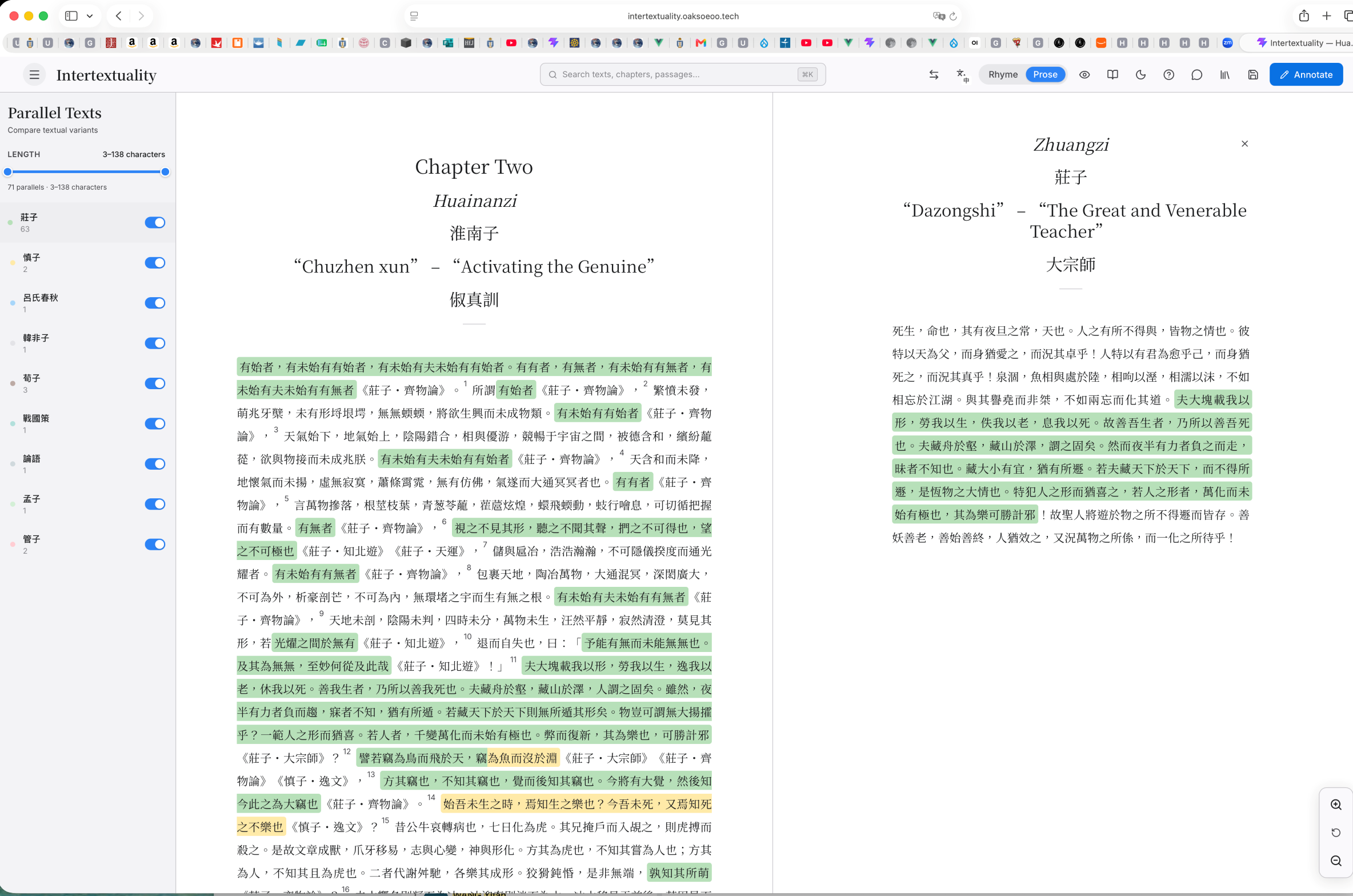
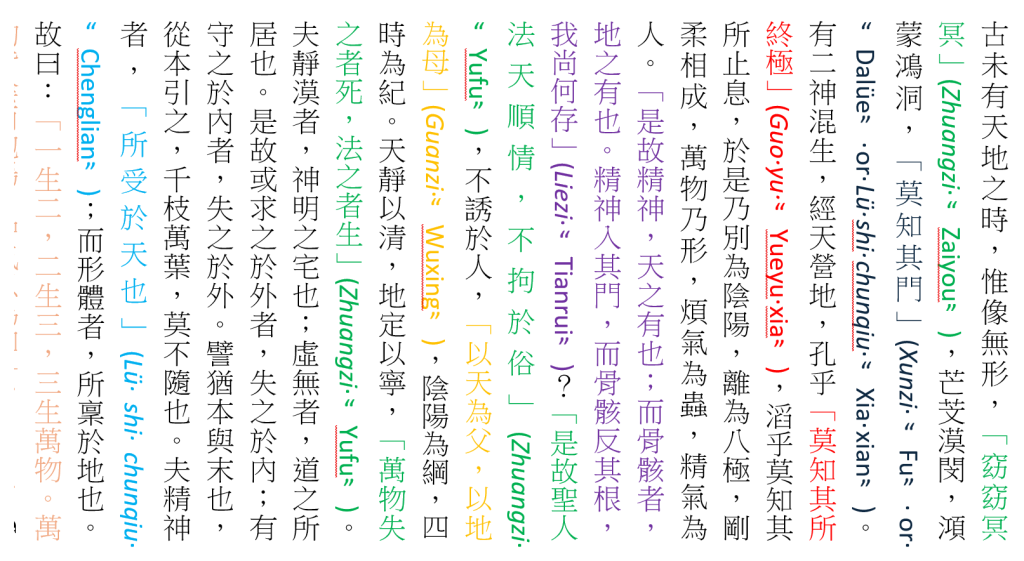
What made this project particularly meaningful was how it deepened my understanding of pre-Qin philosophical texts and introduced me to the concept of textual parallels. Before this project, I had read classical texts primarily as standalone works. Through marking parallels across the Huainanzi, Zhuangzi, Laozi, and Xunzi using CText and the University of Chicago’s Anomanda platform, I came to appreciate the extensive intertextuality among these foundational texts. The process required careful judgment to determine whether similar passages represented genuine textual borrowing or merely coincidental phrasing. I learned that identifying textual parallels involves examining contextual meaning, philosophical alignment, and variant characters—a task that demands more than simple pattern matching.
My main responsibilities included proofreading the Huainanzi text against PDF scans, annotating parallel passages with footnotes containing the original context from parallel sources, and standardizing phonetic annotations based on scholarly references. Later in the project, I worked on integrating English translations from Victor Mair’s Zhuangzi and D.C. Lau’s Laozi, inserting corresponding translations into the footnotes along with complete story translations and page references. This cross-language component required careful cross-referencing between Chinese and English versions and gave me practical experience in multilingual scholarly documentation.
Through this project, I gained a clearer understanding of current AI language models’ capabilities and limitations in processing classical Chinese texts. I observed that while LLMs perform reasonably well with modern standardized texts, they struggle with the ambiguity inherent in pre-Qin writings—multiple interpretations, variant characters, and context-dependent meanings often elude automated processing. This first-hand experience reinforced my view that AI is best positioned as an assistive tool for initial tasks like basic transcription and preliminary alignment, while substantive academic decisions still require human expertise.
The project also gave me insight into academic website design. Since two teammates were responsible for building the project website, our team meetings involved discussions about layout decisions—how to display parallel texts side-by-side, design footnote interaction logic, and enable smooth switching between Chinese and English versions. Participating in these discussions helped me understand that effective scholarly digital platforms require thoughtful information architecture oriented toward researchers’ actual workflows, even though I was not directly involved in coding.
Working with my team was another valuable aspect of this project. Collaborating with passionate colleagues brought productive energy to our work. These discussions helped me realize that digital humanities projects require continuous negotiation between scholarly accuracy and technical feasibility. I benefited not only from the work itself but also from observing how my teammates approached problems from different disciplinary backgrounds.
Looking back, this project deepened my belief in the value of combining traditional humanities scholarship with digital methodologies. This experience has encouraged me to further explore how computational approaches can support, rather than replace, traditional humanities scholarship.