News » New Digital Humanities Project
HKUST Research Team Develops AI Infrastructure for Manchu Historical Sources
A research team led by Professor Michael Yan Hon CHUNG, Assistant Professor in Digital Humanities in the Division of Humanities at The Hong Kong University of Science and Technology (HKUST), has developed a suite of AI tools for reading, digitizing, and analyzing historical Manchu sources. Supported by HKUST’s Digital Humanities Initiative (DHI), the project has grown from an experimental OCR system into a broader digital humanities research infrastructure for Manchu studies.
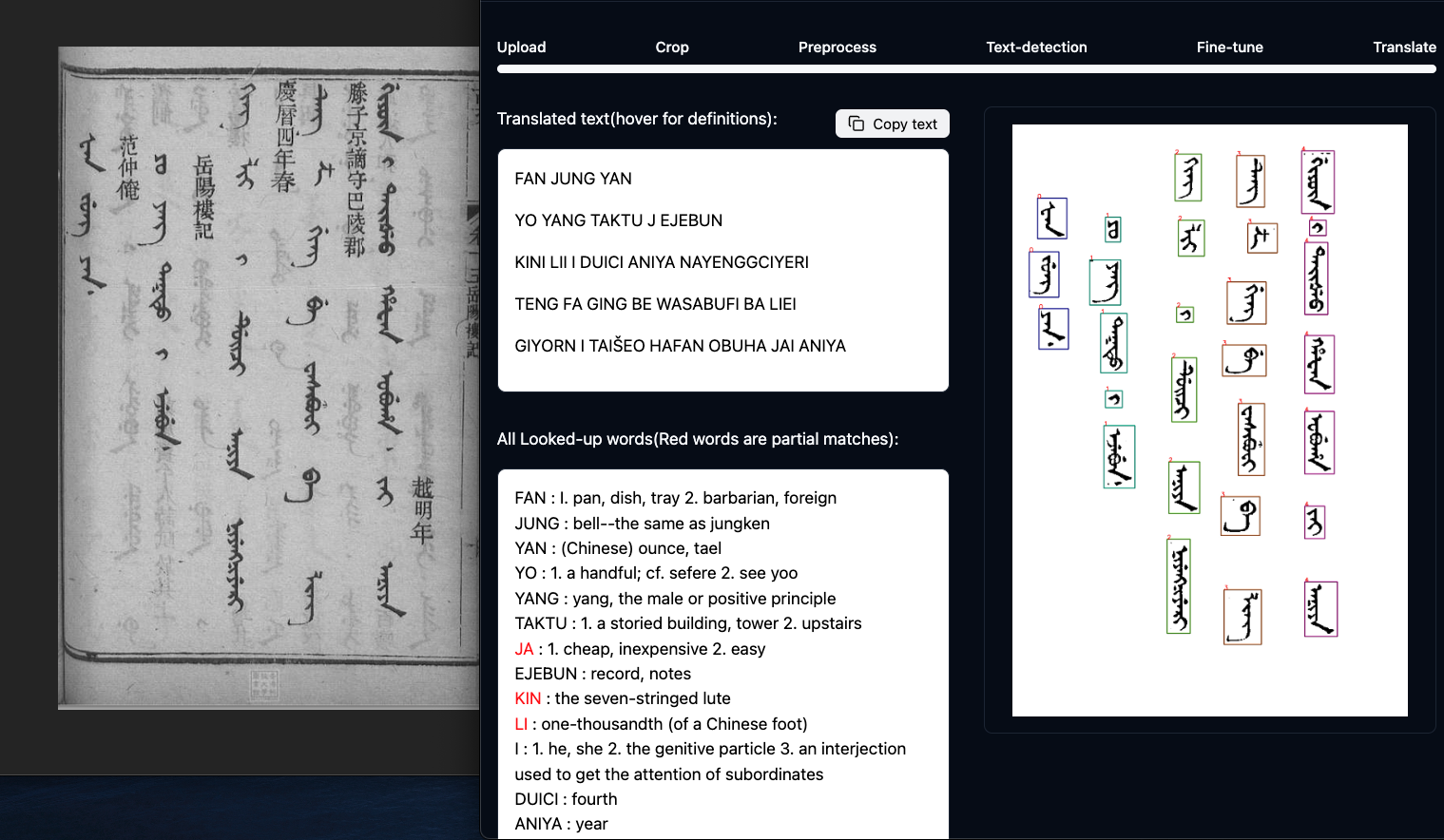
Manchu, now a critically endangered language, was one of the principal languages of the Qing dynasty (1644–1912), and a large body of archival materials survives in the language. Yet much of this material remains available only as scanned images, making large-scale searching and computational analysis difficult. To address this problem, the HKUST team developed a Manchu optical character recognition (OCR) system based on fine-tuned vision-language models, converting scanned historical texts into searchable and machine-readable data. The team has also been developing methods for post-correction, bilingual text alignment, translation, and historical text analysis.
The project has now reached the public through manchu.ai, which has been soft-launched to provide free online Manchu OCR services and access to a growing digital Manchu archive. The platform allows users to move more easily between original document images and machine-readable historical text.
The project has also led to an international collaboration with the Staatsbibliothek zu Berlin (Berlin State Library, SBB), which holds one of the world’s largest collections of Manchu materials. HKUST and SBB have signed a Memorandum of Understanding to apply the Manchu OCR system to SBB’s digitized holdings, with the aim of creating searchable full text for research and digital humanities applications.
The Manchu OCR project has also become part of “Playing Heaven: Remapping Early Modern Neo-Confucian Worlds with AI,” led by Professor Javier Cha at the University of Hong Kong, with Professor Chung serving as a Co-Principal Investigator. Playing Heaven is among the first cohort of projects supported by the Humanities and AI Virtual Institute (HAVI) of Schmidt Sciences and brings together researchers from HKU, HKUST, and the National University of Singapore.
The team will continue improving the OCR and related AI tools, expanding the digital archive, and processing larger collections of historical Manchu materials. The project demonstrates how digital humanities can make difficult historical sources easier to search, compare, and analyze while supporting new forms of research on Qing and East Asian history.
The Digital Humanities Initiative is a joint effort between the Division of Humanities and the Lee Shau Kee Library at HKUST. It supports projects that use digital methods to advance humanities teaching and research and strengthen the visibility of digital humanities scholarship at HKUST and in Hong Kong.