
Discourse Analysis of Women’s Suffrage Movement in British Press (Pre-1928)
Digital Humanities Student Project (Fall 2025)
This project is a course project for HUMA5630 Digital Humanities
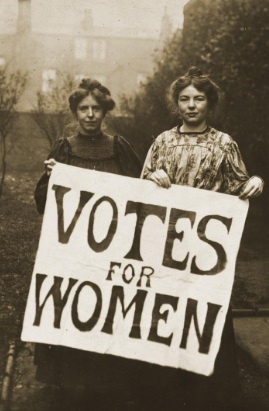
“Let women be what God intended, a helpmate for man, but with totally different duties and vocations.”
——Queen Victoria
About This Project
The women’s suffrage movement was a crucial component of social and political transformation in Britain from the late 19th to the early 20th century. In 1928, the Equal Suffrage Act finally granted British women equal voting rights with men, marking the triumph of decades of suffrage activism. Throughout this process, British newspapers and readers’ letters served as vital platforms for public opinion, reflecting shifting societal attitudes toward women’s suffrage while actively participating in the construction and dissemination of discourse.
Previous studies such as Holton (1986) and Pugh (1999) have examined the development of women’s suffrage movements from historical and political perspectives, but few have systematically analyzed how the media presented, shaped, or even challenged this issue through discourse evolution. This study employs digital humanities methodologies to provide a systematic analysis of media discourse based on the Gale database, aiming to reveal shifts in language, themes, and sentiment over time, and deepening understanding of the interactive relationship between public opinions and social movements. The sources of this study come from British Library Newspapers database in Gale Primary Source. This collection delivers a wide range of newspapers from 18th century to the 2020s.
Data & Technology
Our study employs a combined approach of corpus linguistics and computational text analysis.
Source: British newspapers (e.g. The Times) and readers’ letters from Gale Digital Scholar Lab.
Source Number:
- Times 184
- Exeter and Plymouth Gazette 95
- Aberdeen Journal 90
- Dundee Courier 83
- Derby Daily Telegraph 73
- Western Daily Press 51
- Others 574
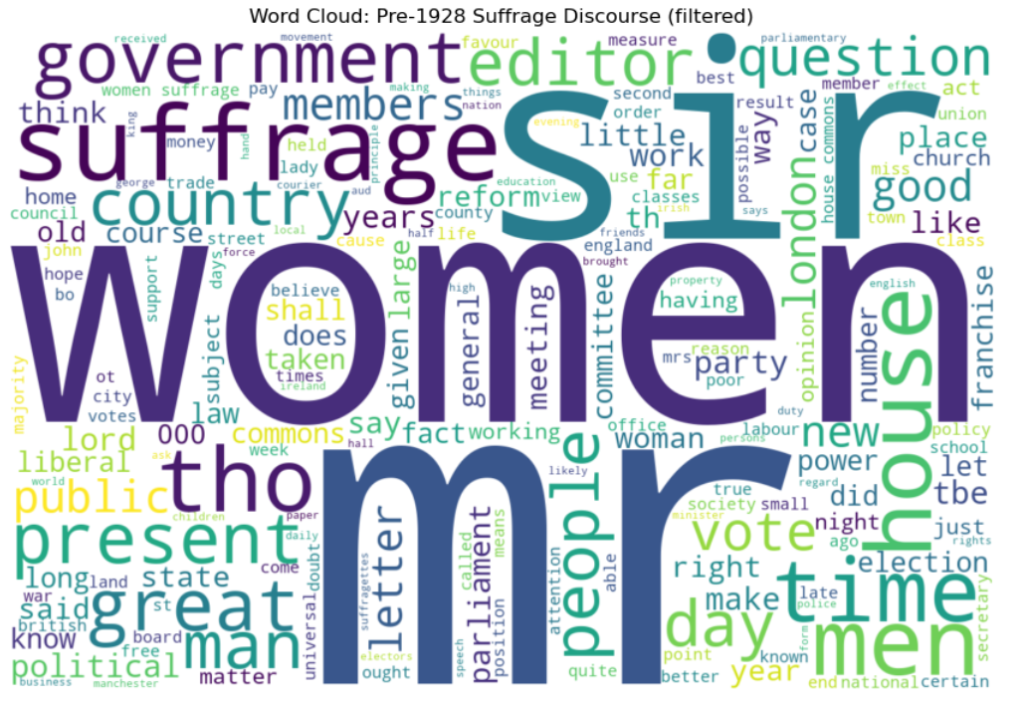
Word Cloud: Pre-1928 Suffrage Discourse
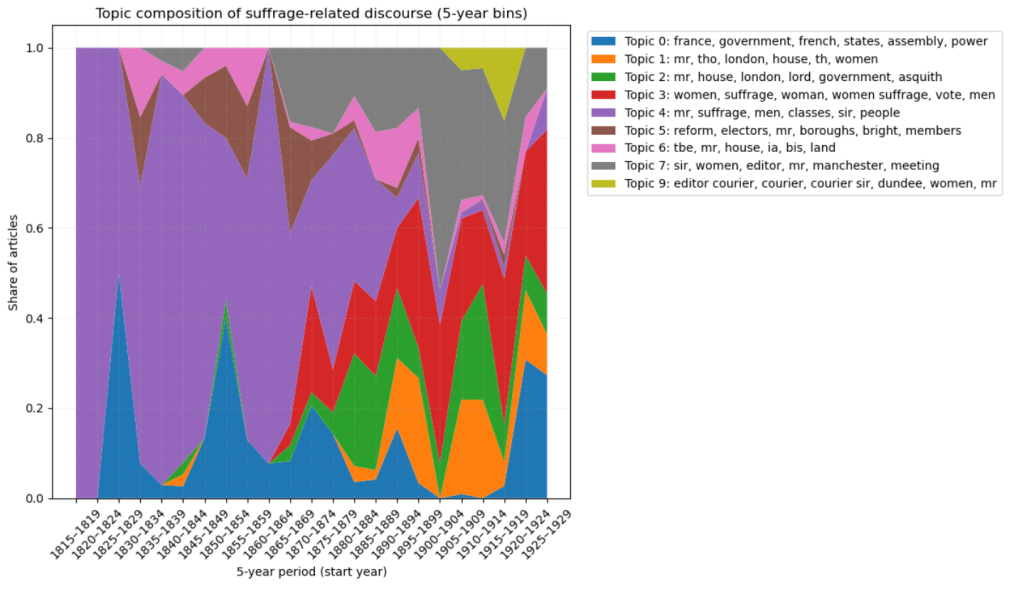
Topic Composition of Suffrage-Related Discourse
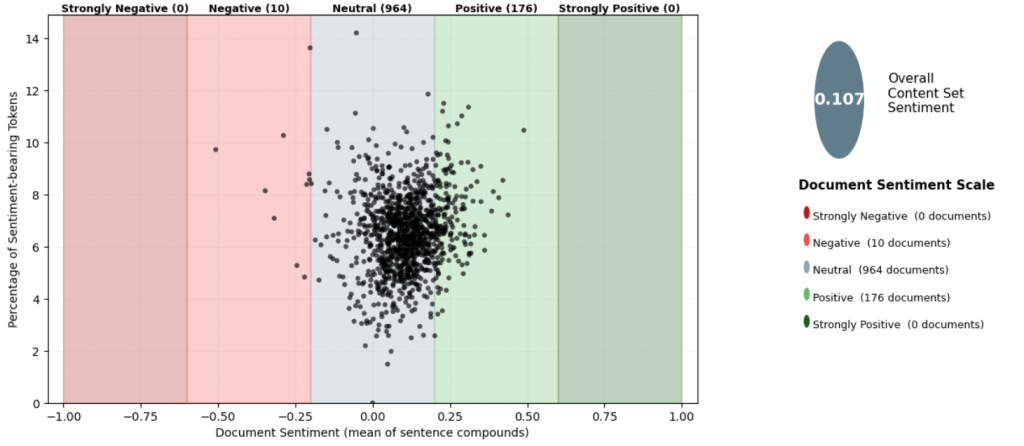
Document Sentiment
Results & Conclusion
In conclusion, this research provides a detailed analysis of British public discourse on women’s suffrage from 1815 to 1929, drawing on newspaper articles and readers’ letters. The study reveals several key findings:
- First, the most prominent terms in suffrage-related discussions were “women”, “suffrage”, and honorifics such as “mr” and “sir”, reflecting both the focus on gender and the formal, male-dominated environment of the time.
- Secondly, discussions were primarily centered on political institutions, voting rights, and the suffrage movement itself, with increased attention and complexity in public debates as the movement matured.
- Third, sentiment analysis shows discourse was generally neutral or mildly positive, with few extreme opinions expressed, indicating a balanced and careful approach in media coverage.
- Finally, over time, the diversity of topics increased, public attention broadened, and references to women’s suffrage intensified as reforms approached.
Group Members
A systematic, large-corpus-based study examining how mainstream public opinions frame women’s suffrage movements and how this framing evolves over time and across events remains a gap in the literature.
Our research aims to complement existing research on women’s suffrage movements by providing a systematic analysis of media discourse, revealing shifts in language, themes, and sentiment over time, and deepening understanding of the interactive relationship between public opinions and social movements.
Yunfei ZHANG
PhD, HKU
Hongming GU
MA Chinese Culture
Yicheng FENG
MSc, University of Copenhagen
Shirong WANG
MSc Global China Studies
GitHub Repository
Please find the detailed code and project documentation at the link below.